


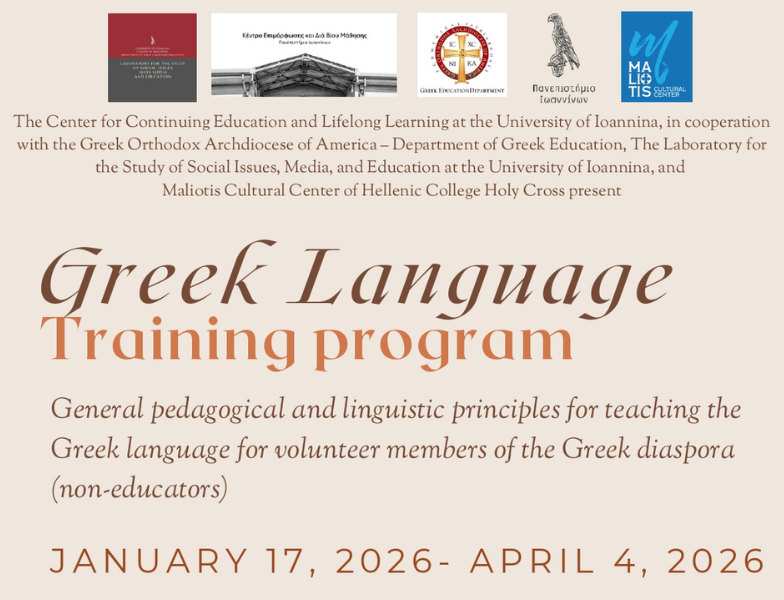

The University of Ioannina is offering a free training program for Greek community volunteers in the US who teach the Greek language. Specifically, the program, titled “General Pedagogical and Linguistic Principles of Teaching of the Greek Language for Volunteers of the Greek Diaspora (non-educators)” is organized by the Center for Continuing Education and Lifelong Learning of the University of Ioannina, in collaboration with the Holy Archdiocese of America, the Laboratory for the Study of Social Issues, Mass Media and Education of the School of Education, and the Maliotis Cultural Center of Hellenic College Holy Cross.
The scientific director of the program is Professor of Linguistics and Greek Language and Dean of the School of Education Sciences at the University of Ioannina, Ms. Nicoletta Tsitsanoudi Mallidi. The program will be carried out within the framework of the International Office of the University of Ioannina, which was recently inaugurated by His Eminence Archbishop Elpidophoros of America and the Rector of the University of Ioannina, Professor Anna Batistatou. The International Office operates under the scientific supervision of Ms. A. Batistatou and Ms. N. Tsitsanoudi Mallidi.
The training program will be conducted online, starting on January 17, 2026, and ending on April 4 of the same year. It will consist of 12 sessions and will initially accept 30 participants, with the possibility of expansion. Participants will be selected based on geographical criteria, so that all Metropolises in the United States are represented, as well as professional criteria, in order to support all those who wish to contribute to the teaching of the Greek language. The program will be taught by academic teachers and professors from Greek and foreign universities.
The program is based on the view of the Greek language not only as a tool for communication, but also as a medium of cultural identity. Its aim is to develop a coherent framework of pedagogical knowledge and teaching skills for volunteers who have no pedagogical training but wish to contribute actively to the preservation and dissemination of our language and cultural heritage.
The structure of the program combines theoretical foundations with practical application. First, the basic challenges in teaching Greek as a cultural heritage language are analyzed, including the management of language errors and the communicative approach. Participants are then introduced to the design of teaching scenarios and the composition of creative activities that utilize literature, music, and mathematical concepts as supportive tools for the development of language awareness.
Emphasis is placed on exploring methodological principles and pedagogical practices that promote active student participation and enhance their autonomy in learning. In this context, the importance of linguistic diversity, the creation of supportive learning environments, and the integration of digital technologies and artificial intelligence will be examined.
In the program, the connection of language with cultural practices—such as poetry, music, and literature—has a dual purpose: on the one hand, to cultivate language skills and creative thinking, and on the other, to strengthen the cultural identity of children in the diaspora. Children are approached as active participants in the learning process, with the program aiming to develop social skills and critical thinking.
The program’s innovation lies in its scientifically documented combination of theory and practice, its creative use of teaching tools, and its emphasis on the Greek language as a vessel of cultural and historical continuity. Upon completion of the program, participants will have acquired not only theoretical knowledge, but also practical skills and teaching scenarios that can be directly applied to their educational practice, thus strengthening the sustainability of Greek-language education in diaspora communities.
Information, expression of interest: Diaspora Volunteers training program


